Scriptix
AI Automation vs Traditional Software: Which Fits Your Business?
Introduction
In 2025, companies frequently make strategic errors by selecting technologies based on market trends rather than genuine business needs. Many organizations either underestimate AI's potential or deploy it to solve problems better handled by deterministic systems. This framework helps determine whether AI automation, traditional software, or both suits your business requirements.
Defining the Terms
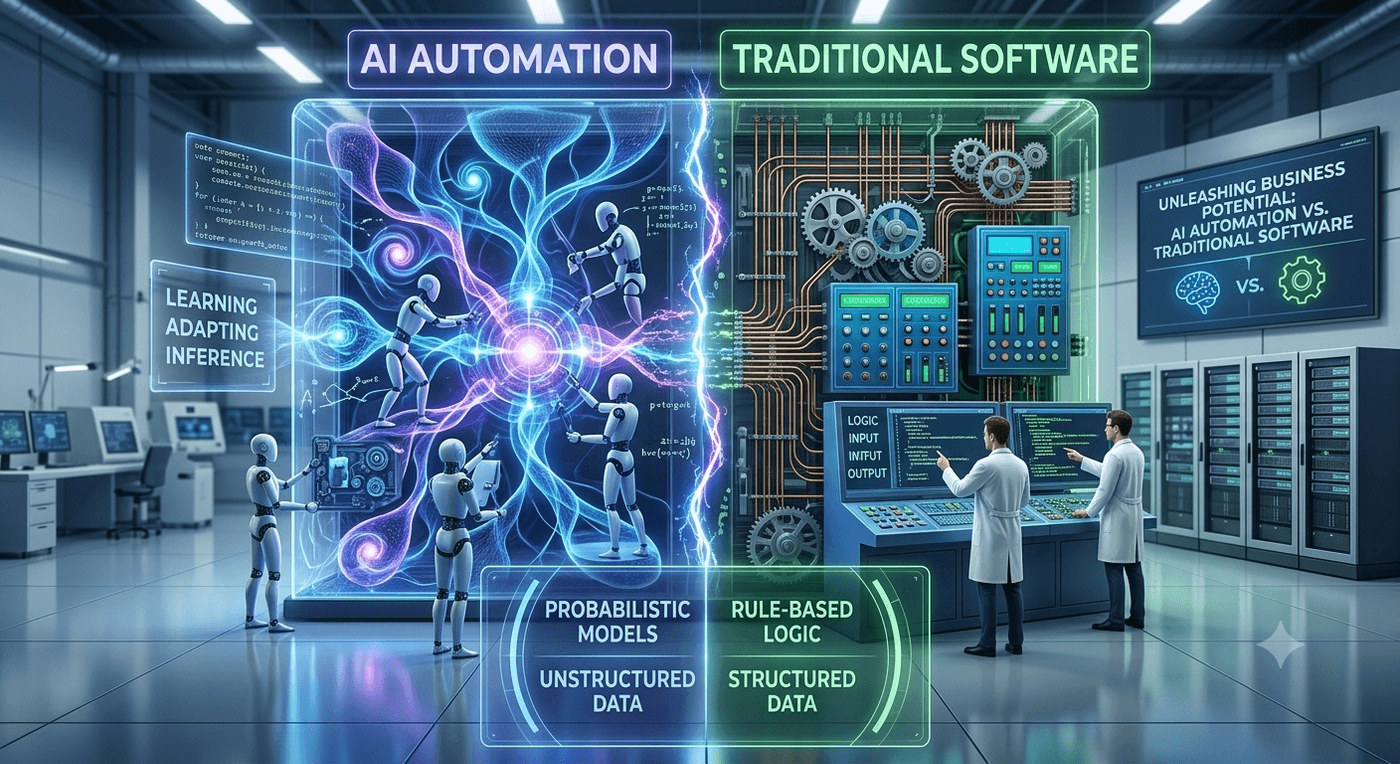
Traditional Software (Rule-Based Systems) are deterministic systems where developers define explicit logic: if X occurs, execute Y. Identical inputs consistently produce identical outputs. Common applications include ERP systems, payment engines, invoice generators, authentication mechanisms, and workflow management tools. All rules are defined, testable, and fully auditable.
AI Automation systems leverage machine learning models, neural networks, or LLMs to process unpredictable inputs. The system identifies patterns within data and generates probabilistic conclusions. Applications span natural language processing, image classification, demand forecasting, anomaly detection, and generative content creation. Output reflects contextual understanding rather than predetermined outcomes.
Head-to-Head Comparison
| Dimension | AI Automation | Traditional Software |
|---|---|---|
| Input types | Unstructured (text, images, voice, video) | Structured (forms, databases, APIs) |
| Decision logic | Probabilistic; learned from data | Deterministic; hard-coded rules |
| Explainability | Often opaque; requires extra work (LIME, SHAP) | Completely auditable; every decision traceable |
| Accuracy | High for pattern recognition; potential for hallucinations | 100% accuracy on defined rules; fails on unexpected edge cases |
| Development cost | Higher (data prep, training, MLOps infrastructure) | Lower for well-defined requirements |
| Operational cost | Scales with volume and model size | Minimal at scale; computationally efficient |
| Maintenance | Requires monitoring, retraining, drift detection | Remains stable; changes only when rules change |
| Compliance | Difficult to certify; auditability challenges | Straightforward regulatory auditing |
| Speed to first value | Months (pipeline development, training, evaluation) | Weeks (clear specifications, standard tools) |
When AI Wins
Use AI for inherently non-deterministic problems: when comprehensive rules cannot address all scenarios, or rule maintenance costs exceed model development expenses.
- check_circleLanguage understanding: Intent classification, sentiment analysis, document summarization, multilingual processing.
- check_circleComputer vision: Defect detection, receipt scanning, identity verification, medical imaging.
- check_circleForecasting and prediction: Demand projection, churn modeling, credit assessment, dynamic pricing.
- check_circleContent generation: Automated reporting, personalized marketing messaging, code development.
- check_circlePersonalization at scale: Recommendation systems, adaptive interfaces, individualized pricing.
When Traditional Software Wins
Use traditional software when logic is defined and accountability is critical, in cases where rules remain consistent and require complete auditability.
- check_circleFinancial calculations: Tax determination, payroll processing, invoice creation, interest computation.
- check_circleWorkflow automation: Approval chains, onboarding sequences, SLA monitoring.
- check_circleAuthentication and access control: Role-based permissions, OAuth implementation, session administration.
- check_circleRegulatory reporting: IFRS/GAAP compliance, GDPR workflows, SOC 2 documentation.
- check_circleHigh-volume standardized operations: Processing millions of identical transactions where AI inference costs would become prohibitive.
The Hybrid Architecture: Leveraging Both Approaches
The most successful enterprise systems combine AI and traditional software strategically. A typical pattern: a customer support request arrives containing unstructured text. An AI classifier identifies the subject matter, emotional tone, and priority level with high (though never perfect) accuracy. A routing engine applies deterministic rules: priority tickets proceed immediately to advanced support, and billing inquiries transfer to accounting. An LLM suggests response language based on existing knowledge. A human representative reviews and sends the communication. An audit system records all actions for compliance verification. Neither approach independently delivers this level of effectiveness and economy.
Decision Framework for Business Leaders
Can I write all the rules? Choose traditional software for predictable scenarios. Opt for AI when cases become too numerous or unpredictable to fully document.
Does an incorrect answer carry serious consequences? For financial, legal, or safety-critical situations, traditional software should make decisions, with AI providing supporting data.
Do I have training data? Models require labeled historical examples. Without this data, building a reliable system becomes impossible.
What is the cost at scale? High-volume, routine processes may see AI inference costs exceed traditional rule execution significantly. Evaluate economics carefully.
Conclusion
These approaches complement rather than compete with one another. Successful enterprises in 2025 deploy each technology where it demonstrates genuine advantage: AI for ambiguous problems and pattern recognition, traditional code for rule-based decisions and compliance. The primary pitfall involves misapplying AI to problems suited for deterministic systems.
Not Sure Which Approach Fits?
Scriptix assists organizations in selecting appropriate technology solutions, whether that means AI automation, custom software, or a hybrid of both.
Get in Touch